Advancing Affordable Energy Initiatives and Environmental Resilience
- Continued to advance construction of the Revolution Wind project — the first large-scale offshore wind farm for Connecticut and the first multi-state offshore wind farm in the nation. Despite repeated attempts by the Trump Administration to terminate the project prior to completion, Rhode Island has fought to keep the project moving forward. Revolution Wind is directly creating roughly 1,200 jobs across Rhode Island and Connecticut, strengthening the region’s blue-economy workforce and union partnerships, and investing in critical port infrastructure. Scheduled to be fully online in 2026, the project will be able to deliver clean, reliable power to more than 350,000 households — helping to lower energy costs for Rhode Islanders and reduce regional carbon emissions.
- Directed the Division of Public Utilities and Carriers (DPUC) to negotiate and secure a deal that will provide at least $150 million in hold harmless credits from the sale of National Grid to PPL Corporation.
- Published the 2025 Climate Action Strategy as required by the Act on Climate, providing a comprehensive assessment of Rhode Island’s emissions trajectory. The Strategy outlines the immediate and serious impacts of recent federal policy changes, including the rollback of clean-energy and clean-vehicle incentives, efforts to stall offshore wind, and the elimination of key federal programs, and signals a necessary shift toward prioritizing energy affordability for ratepayers and recalibrating emissions-reduction strategies in light of the current federal landscape.
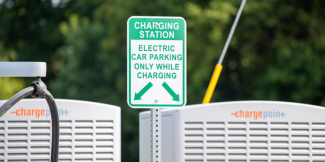
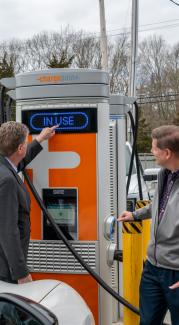
- Submitted and implemented a successful statewide plan for electric-vehicle infrastructure deployment, securing $22.9 million through the Federal Highway Administration’s National Electric Vehicle Infrastructure (NEVI) Formula Program. Rhode Island became the first state in the nation to complete NEVI Phase 1 and the first to launch Phase 2—accelerating the build-out of fast-charging stations across key travel corridors.
- Expanded access to affordable, efficient home heating through the Office of Energy Resources’ (OER) Clean Heat RI program, with more than 4,000 households participating to date. The program provides financial incentives to help Rhode Islanders install high-efficiency heat pumps—lowering energy costs, improving home comfort, and reducing emissions.
- Increased transparency in the use of state and federal energy funds through the launch of new public dashboards, including EV, E-Bike, PowerUp RI, and Lead by Example dashboards.
- Published Resilient Rhody 2025, Rhode Island’s first statewide coastal resilience plan, addressing increasing risks from sea level rise, flooding, and severe storms through a comprehensive vulnerability assessment of public built and natural assets, updated statewide resilience actions, prioritized project solutions with cost estimates, and a funding and investment strategy to advance implementation across coastal and riverine communities.
- Signed legislation in 2025 creating the Resilient Rhody Infrastructure Fund, a permanent, dedicated, revolving source of low-interest financing to help municipalities invest in climate-resilient infrastructure projects such as stormwater upgrades, floodproofing, watershed restoration, urban tree planting, and coastal resilience.
- Advanced major resilience upgrades to Rhode Island’s working waterfronts—building on a nearly $15.5 million FEMA Hazard Mitigation Grant with a 10 percent state match, the largest such award in state history—by:
- Continued implementation of the $21.43 million Phase IV Improvements to the Port of Galilee project, scheduled for completion in winter 2026, including construction of a new 450-linear-foot steel sheet-pile bulkhead, reconstruction of Pier I, and associated landside and utility improvements; and designed and permitted reconstruction of Piers A and G for construction in 2026.
- Advanced a public-private partnership at the former Chase Marina in Tiverton by removing derelict timber piles, securing Coastal Resources Management Council and Water Quality Certification approvals, and moving the project to near-final permitting, with construction targeted for 2026 at an estimated cost of $4.1 million.
- Announced the availability of $5 million in Outdoor Recreation Grant funding through DEM to support municipalities and eligible Tribal governments in acquiring, developing, and renovating outdoor recreational facilities, leveraging voter-approved Green Bond investments and continuing a long-standing program that has awarded more than $92 million in grants statewide to improve public health, community spaces, and quality of life across all 39 communities.
- Awarded $2.71 million through the Brownfields Remediation and Economic Development Fund to support cleanup and redevelopment of contaminated sites statewide, funding 10 projects across four municipalities and leveraging voter-approved Green Bond investments to spur approximately 682 construction jobs and 453 permanent jobs while returning long-neglected sites to productive use.
- Awarded more than $2 million through the first round of the 2024 Ocean State Climate Adaptation and Resilience (OSCAR) Fund to support 13 projects advancing flood mitigation, habitat restoration, and shoreline improvements across coastal and riverine communities, strengthening resilience to climate impacts statewide.
- Advanced, through DEM, major capital improvements across Rhode Island’s state beaches and campgrounds to modernize facilities and enhance accessibility, including construction of a new bulkhead and boardwalk at Roger Wheeler State Beach, a redesigned entrance with additional lanes at Misquamicut State Beach to ease congestion, and completion of Phase 1 restroom upgrades at Burlingame Campground in 2025, with Phase 2 underway to deliver new shower and restroom facilities by 2027.
- Reopened the 2,300-acre Alton Jones Campus under a collaborative agreement between URI and DEM, supporting new investments in critical infrastructure and natural resource protection to enhance access, stewardship, and outdoor learning opportunities.
- Continued to invest in the Local Agriculture and Seafood Act (LASA) program to strengthen Rhode Island’s agricultural and seafood sectors, awarding $486,000 in 2025 to 33 local farmers, fishers, specialty food producers, and food businesses to support growth, development, and marketing activities that expand local food production, reduce environmental impacts, and improve food security statewide.
- Continued to grow LitterFree Rhode Island into a flagship, statewide antilitter effort that mobilizes residents through community engagement, cleanups, and education to protect the Ocean State’s natural resources. Expanded the interactive “TrashBoard” to showcase progress, including more than 904 tons of large litter items collected in 2025, 7,046 community bags filled, 28,000 bags removed from state highways, a 25 percent increase in AdoptaSpot participation, distribution of a LitterFree Rhode Island coloring book and a new RI Interscholastic League partnership to engage youth, as well as funding for 108 local cleanup projects, with six additional beautification projects slated for 2026.

The Road to RI 2030: Goals for Advancing Affordable Energy Initiatives and Environmental Resilience
- Advance a ratepayer-relief budget article in the FY 2027 budget to moderate near-term utility costs by expanding eligibility for zero-emission technologies, aligning Rhode Island’s programs with peer states, and reducing the roughly 25% of electric bills made up of state fees and taxes to more affordable, sustainable levels — establishing a more affordable path to decarbonization that delivers over $150 million in ratepayer relief in 2027 alone and more than $1 billion in savings over five years.
- Advance a $50 million Green Economy and Clean Energy Bond on the November 2026 ballot to fund brownfield remediation, facility improvements, local recreation grants, marine infrastructure, climate resiliency projects, and the State’s first-ever energy-efficiency bond.
- Sign an Executive Order to reduce energy costs and accelerate clean-energy development by directing the Office of Energy Resources to (1) review the Net Metering and Renewable Energy Growth programs to control ratepayer costs while supporting emissions goals; (2) lead a cross-agency effort to identify and remove permitting, siting, and interconnection barriers that delay clean-energy projects; and (3) require the Division of Public Utilities and Carriers to provide clear Ratepayer Impact Notes on major energy legislation so policymakers and the public understand projected bill impacts.
- Advance an all of the above energy strategy that lowers costs through expanding baseload and intermittent energy supply and advocate for Jones Act reform at the federal level to lower winter costs.
- Support the Executive Climate Change Coordinating Council, DEM, OER, and partner agencies in evaluating the devastating impacts of the Trump Administration’s clean-energy policy and funding rollbacks on Rhode Island’s ability to implement the Act on Climate.
- Ensure that any recalibration of strategies or mandates occurs through a transparent public process and pursues emissions-reduction goals that are evidence-based and informed by scientific analysis, while balancing feasibility, ratepayer affordability, and current federal and regional conditions.
- Continue to invest in preparedness through the Municipal Resiliency Program, protecting infrastructure in coastal and riverine communities from storms and floods due to climate change.
- Increase support for additional initiatives to help communities most affected by pollution and lack of access to green spaces throughout the state.